
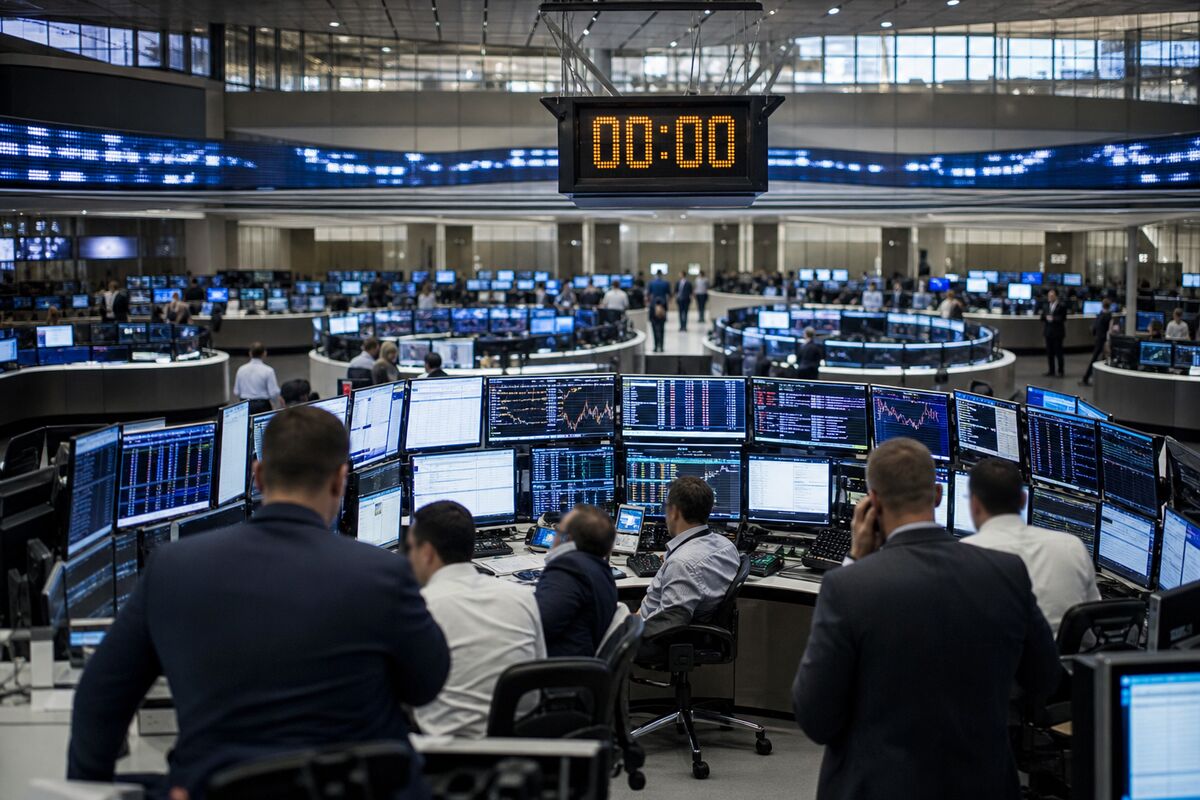
Triple witching lands on the third Friday of March, June, September and December: the last 2026 date is Friday, December 18, and the 2027 dates are March 19, June 17 (a Thursday, because markets close Friday, June 18 for Juneteenth), September 17 and December 17. That is the quarterly session when stock options, stock index options and stock index futures all expire on the same day. It reliably brings a crush of volume. What it has not brought, on the numbers, is bigger index moves. Across 147 quarterly expirations since 1990, the S&P 500's median absolute move on expiration day was 0.46%, a touch smaller than the 0.52% median for all sessions.
So the folklore is half right. The volume is real. The price drama mostly isn't.
Triple witching dates for the rest of 2026 and 2027
The base rule is simple. Standard monthly options expire on the third Friday of the month, and the March, June, September and December expirations are the quarterly ones where the three contract families line up. The wrinkle is holidays. Cboe's S&P 500 options specifications state that when a holiday falls on the settlement date, it "is moved back one business day (e.g. from Friday to Thursday)." The Options Industry Council applies the same logic to weekly options: if the Friday is an OCC holiday, the series expires on the Thursday before.
Run the calendar against the NYSE holiday schedule and two quarters need a second look:
| Quarter | Third Friday | Exchange status | Expiration session |
|---|---|---|---|
| March 2026 | Mar 20, 2026 | Open | Fri, Mar 20, 2026 (past) |
| June 2026 | Jun 19, 2026 | Closed, Juneteenth | Thu, Jun 18, 2026 (past) |
| September 2026 | Sep 18, 2026 | Open | Fri, Sep 18, 2026 (past) |
| December 2026 | Dec 18, 2026 | Open | Fri, Dec 18, 2026 |
| March 2027 | Mar 19, 2027 | Open (Good Friday is Mar 26) | Fri, Mar 19, 2027 |
| June 2027 | Jun 18, 2027 | Closed, Juneteenth observed | Thu, Jun 17, 2027 under the holiday rule |
| September 2027 | Sep 17, 2027 | Open | Fri, Sep 17, 2027 |
| December 2027 | Dec 17, 2027 | Open (Christmas observed Dec 24) | Fri, Dec 17, 2027 |
June is the month that trips people up. In 2026, Juneteenth fell on the third Friday itself, Cboe and NYSE were both closed on June 19, and Cboe's S&P 500 history shows no session that day. The quarterly expiration ran on Thursday, June 18, 2026. In 2027, Juneteenth falls on a Saturday, and NYSE lists the holiday as observed on Friday, June 18, 2027; Cboe's options holiday table shows no regular trading hours that day. Same result, one year later: the published rule points to Thursday, June 17, 2027.
One caution. As of November 3, 2026, we could not find a published 2027 expiration calendar from OCC or Cboe. The 2027 dates above come from calendar arithmetic plus the exchanges' holiday rules. Confirm them when the official calendars post.
What actually expires, and why it is "triple"
An SEC release from August 2009 (Release No. 34-60548) spells out the definition: stock index futures, stock index options and stock options "all expire on the same days occurring on the third Friday of March, June, September, and December." Cboe's own settlement guide uses the same three: individual stock options, equity index options and equity index futures.
- Stock and ETF options. The standard monthly contracts on names like $AAPL or $SPY roll off with the third-Friday cycle.
- Stock index options. The standard, third-Friday SPX contract is the big one, plus its PM-settled cousins (more below).
- Stock index futures. The quarterly contracts on the major indexes expire the same day.
Every month has a third-Friday expiration. Only four a year stack all three families on one session.
AM-settled vs PM-settled SPX: two expirations on one day
Here is the detail that matters most for index traders. Cboe lists two kinds of S&P 500 options that expire on the third Friday, and they settle at different times of day.
| Feature | Standard SPX | SPX Weeklys (SPXW) |
|---|---|---|
| Settlement | AM | PM |
| Settles to | Special Opening Quotation (SOQ), published as SET | Closing values on expiration day |
| Last trading | Ordinarily the business day before (usually a Thursday) | Expiration day, 4:00 pm ET (1:00 pm ET on half days) |
| Exercise style | European | European |
The AM-settled SOQ is built from the opening trade price of each S&P 500 stock in its primary market, so it is not calculated until every constituent has opened. That creates a quirk. According to Cboe's settlement guide, the SOQ fell outside the S&P 500's daily high-low range on roughly 30% of quarterly AM-settled expirations between March 2009 and March 2024, most often above the high. Its deviation from the index's opening value ranged from -0.98% to +1.00% in that sample.
Why the morning settlement at all? Cboe says early cash-settled index options used closing prices, and the SEC had concerns about volatility and sharp moves near the close on expiration days. The shift to AM settlement began in 1987 and Cboe moved all standard SPX options to it in 1992. In other words, the contract was redesigned to take its settlement away from the closing bell. For a fuller breakdown of the two products, see our guide to SPX vs SPY options.
Does triple witching really move the market?
We checked the tape. Using Cboe's S&P 500 price history from January 2, 1990 through the October 30, 2026 close, there were 147 quarterly expiration sessions (two shifted to a Thursday by a holiday: March 20, 2008 and June 18, 2026). The comparison is close-to-close, price only:
| S&P 500, 1990 to Oct 30, 2026 | Quarterly expiration days | All sessions | All Fridays |
|---|---|---|---|
| Median absolute daily move | 0.46% | 0.52% | 0.52% |
| Mean absolute daily move | 0.66% | 0.76% | 0.75% |
| Share of days moving more than 1% | 24% | 26% | n/a |
On every measure, witching days were a shade calmer than an average session, not wilder. Cboe itself notes "an observed increase in trading volume and market volatility" on quarterly expirations as traders close, roll or offset positions. Both can be true: heavy volume and intraday churn without an unusually large net move by 4:00 pm.
The recent record shows the range:
| Expiration session | S&P 500 close | Daily change |
|---|---|---|
| Mar 21, 2025 | 5,667.56 | +0.08% |
| Jun 20, 2025 | 5,967.84 | -0.22% |
| Sep 19, 2025 | 6,664.36 | +0.49% |
| Dec 19, 2025 | 6,834.50 | +0.88% |
| Mar 20, 2026 | 6,506.48 | -1.51% |
| Jun 18, 2026 (Thursday) | 7,500.58 | +1.08% |
| Sep 18, 2026 | 7,650.50 | +0.17% |
Two of seven cleared 1%, in opposite directions. Five were quiet. Two of seven is 29%, close to the 26% of all sessions that move more than 1%, which is the point. The S&P 500 closed at 7,580.07 on October 30, 2026, heading into the December 18 expiration; the history says nothing about which way that day breaks.
How traders use the witching calendar
The date matters less as a signal and more as a scheduling fact. A few practical angles:
- Know which SPX you hold. An AM-settled position stops trading the business day before and settles off Friday's opening prints. A PM-settled SPXW position trades into the close. Holding one while hedging with the other creates overnight gap risk.
- Watch the roll, not the headline. Futures and options positions get rolled to the next quarter in the days around expiration, so volume and open interest shift fast. Flow that looks dramatic may be routine rolling; our guide to the expected move formula helps size what options are actually pricing.
- Mind the session hours. SPX also trades in Cboe's Global Trading Hours session, which matters for gaps into an AM settlement. See how extended options hours reshape trading around the open and close.
- Check volatility context. For a read on stress, the VIX term structure says more than the calendar does.
For more desk explainers on options flow, volatility and expirations, start at the Wall Street War Room homepage.
Desk Notes
What the numbers say: Across 147 quarterly expirations since 1990, the S&P 500's median absolute move was 0.46% vs 0.52% for all sessions, and 24% of witching days moved more than 1% vs 26% overall.
What they don't: Close-to-close data miss intraday swings, the opening settlement print and single-stock pinning, and they say nothing about the direction of any future expiration.
FAQ
When is the next triple witching date?
Friday, December 18, 2026. After that come March 19, 2027, Thursday, June 17, 2027 (Juneteenth is observed on Friday, June 18), September 17, 2027 and December 17, 2027. Confirm the 2027 dates against the OCC and Cboe calendars once they are published.
Is it triple witching or quadruple witching?
Both labels show up for the same quarterly date. The SEC and Cboe definitions name three expiring families: stock options, stock index options and stock index futures. OneChicago, which the SEC describes as an exchange that operated solely for trading security futures products, ceased trading operations on September 18, 2020.
When do standard SPX options stop trading on triple witching?
Trading in AM-settled SPX ordinarily ends the business day before expiration, usually Thursday, and the contracts settle to the SOQ from Friday's opening prices. Cboe's wording ties the last trading day to the business day before the settlement value is calculated, so a holiday that pulls expiration to Thursday pulls the last trade earlier too. PM-settled SPXW trades until 4:00 pm ET on expiration day.
Is triple witching bad for stocks?
Not on the record. Since 1990, S&P 500 moves on quarterly expiration days have been slightly smaller than on an average session, with a 0.46% median absolute move vs 0.52%. Volume is heavy; the net price move historically has not been unusual. Past patterns are not a forecast.